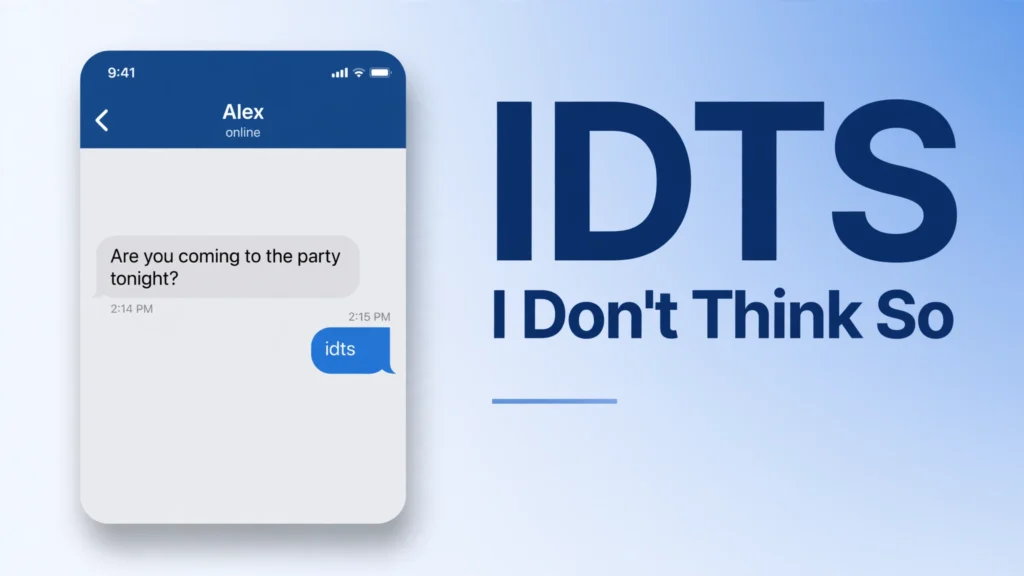

You open a message and see four letters, idts, sitting on their own. No emoji. No extra words. You are left guessing if the person said no, disagreed with you, or just was not sure. That little pause is exactly why people search for idts meaning in text in the first place. IDTS is short and fast, and it is easy to misread when you do not know the person well. This page gives you the plain meaning first. Then it shows how tone, punctuation, and the chat around it can make the same four letters feel soft, playful, or firm. By the end, you will know when IDTS is a joke, when it is a soft no, and when it is a real doubt worth answering properly.

That pause after a bare idts is exactly what sends most people to search for its meaning.
IDTS Meaning in Text, a Quick Definition
IDTS stands for I don’t think so. People use IDTS in texts and chats to say they doubt something, disagree softly, or believe the answer is probably no. It is an opinion, not missing information, and it is softer than a flat no.
Each letter comes from one word in the full phrase, as this breakdown shows.
| Letter | Word |
| I | I |
| D | Don’t |
| T | Think |
| S | So |
IDTS is an initialism, built from the first letters of the phrase. In speech, people say the full phrase instead of spelling out the letters. IDTS and idts mean the same thing, and lowercase looks more relaxed.
Short Examples
Three quick exchanges show its main jobs.
“Is the shop still open?” “IDTS, it closed at nine.” (probable no)
“Do you think this photo is real?” “IDTS. The shadows look wrong.” (disbelief)
“Will Sam pass on the first try?” “IDTS, but he is close.” (doubt with room left open)
Origin and Background of IDTS
IDTS grew out of the spoken phrase I don’t think so once texting and chat rooms rewarded shorter replies. Its exact origin is not clear, and no single person or platform can be credited with it. Online examples show it was already in use by the early 2000s.
That pattern matches chat short forms from the same period, such as IDK and BRB. The habit stayed, because a four letter reply is faster and still carries a clear attitude.
What IDTS Means Emotionally, Tone and Certainty
IDTS sits in the middle of the certainty scale, leaning toward no but rarely closing the door. The sender has formed a view, yet leaves more room than definitely not. That middle position is why tone matters so much here.
This scale shows where IDTS lands.
| Expression | Certainty | How It Reads |
| I’m not sure | Low | No view yet |
| IDTS | Medium, leaning no | Doubt or soft disagreement |
| Probably not | Medium to high | A likely no |
| Definitely not | High | A firm, closed no |
Context does the rest. Between close friends, IDTS often reads as light and even funny. In a tense chat, the same reply can feel cold.
How Punctuation Changes IDTS
Punctuation changes how IDTS sounds, even though the words stay the same. A period makes it firmer, like “IDTS.” Dots after it, like “idts…”, suggest hesitation, as if the sender is still thinking.
Lowercase idts feels casual and quick. All caps can look a little stronger, but it is also the standard way to write a short form. An emoji softens the reply fast, and idts with a laughing emoji rarely sounds serious.
Real-Life Conversations Using IDTS
IDTS keeps the same meaning on WhatsApp, Instagram, TikTok, and Snapchat. The platform changes the setting, not the definition. On Snapchat, a story reply like “idts, he was home all night” is just a quick doubt, typed fast.

Between friends, an idts often lands as part of the joke, not a real argument.
WhatsApp Conversation
On WhatsApp, IDTS often works as a soft no about a plan.
Rania: Are we still leaving at six?
Omar: IDTS. Traffic near the bridge is awful right now.
Rania: Seven then?
Omar: That works.
Omar is not refusing the trip. He doubts the timing, and his reason comes right after it.
Instagram DM
In Instagram DMs, IDTS often carries a teasing tone.
Lena: I could totally win that singing contest.
Noah: idts lol, I have heard you in the car.
Lena: Rude. Accurate, but rude.
Noah disagrees, but the add-ons show both people are joking, and the chat keeps moving.
TikTok Comments
In TikTok comments, IDTS often shows doubt about a claim in a video.
Comment 1: He solved that puzzle in ten seconds, no cuts.
Comment 2: IDTS. The clock in the corner jumps.
Comment 3: Good catch, it does.
Here, IDTS questions the claim, not the person. The evidence in the next line makes it read as fair, not rude.
IDTS vs Similar Texting Terms
IDTS gives an opinion that leans no, while IDK says the person has no information to give. That is the difference people mix up most, and this table separates the terms clearly.
| Term | Meaning | Difference From IDTS |
| IDTS | I don’t think so | An opinion leaning no |
| IDK | I don’t know | No information, no opinion |
| IDT | I don’t think | The same idea, left unfinished |
| IDC | I don’t care | No interest, can sound blunt |
| IMO | In my opinion | Opens an opinion, says nothing about yes or no |
| TBH | To be honest | Adds honesty or emphasis to any reply |
| NVM | Never mind | Withdraws an earlier message |
Picking the wrong one changes the message. Swapping in IDC by mistake is the risky one, since a reply about doubt can suddenly read as a reply about not caring.
Variations and Related Forms of IDTS
IDTS has only a few real forms. Most of the longer list you see online is related phrases, not versions of IDTS itself. This table keeps the real forms at the top, grouped by tone.
| Form or Phrase | Tone | What It Adds |
| idts | Casual | The relaxed, lowercase everyday form |
| idts lol | Playful | Doubt softened by humor |
| IDTS tbh | Honest, direct | A frank opinion, stated plainly |
| I doubt it | Mild | Doubt in full words, safe with anyone |
| Probably not | Mild to firm | A likely no, with a reason usually expected |
| I don’t think that’s right | Neutral | Disagreement aimed at the claim |
| Nah / Nope | Firm, casual | A closed no in friendly settings |
| Not a chance | Strong | A firm no with no room left |
Use the mild rows when you want the chat to stay open. Save the strong rows for when the answer is final.
How to Respond When Someone Uses IDTS
How you respond to IDTS depends on whether the person sounded playful, unsure, or firm. A follow-up question works best when their tone is unclear. These styles cover the four situations that come up most.
Casual Replies
Casual replies fit friendly chats.
“Fair enough, what would work better for you?”
“Ha, okay, I will take that as a maybe.”
Both accept the doubt without pushing back, and keep the plan, or the joke, alive.
Funny Replies
Funny replies work when the IDTS was clearly a joke.
“Wow, zero faith in me. Noted.”
“idts energy from you, as always.”
Keep the joke aimed at the situation, not the person. If their reply had no softener, skip the comedy and answer plainly.
Mature or Confident Replies
Mature replies treat IDTS as a real opinion, and ask why.
“Got it. What part feels off to you?”
“Okay, show me what you are seeing.”
These replies move the chat forward, and give the other person a fair chance to explain a doubt that might be right.
Private or Respectful Replies
Respectful replies matter when the topic is personal.
“No pressure either way. Tell me when you have thought it over.”
“I hear you. Do you want to talk about it later instead?”
A reply like this gives the person space, and avoids turning a soft no into an argument.
When Not to Use IDTS, Work and Formal Messages
IDTS should stay out of professional email, applications, and messages to people you do not know well. There, a short form can look lazy or dismissive, even when you meant it lightly. Write the full phrase instead, and add your reason, like this.

At work, the full phrase always reads better than the short form.
“I don’t think that is the right approach, because the numbers do not support it.”
“I am not sure about that yet. Let me check and confirm.”
“Based on the current schedule, I do not expect we will finish by Friday.”
In a relaxed team chat with coworkers you know well, IDTS is usually fine. If the message could be forwarded to a manager, spell it out.
Common Misunderstandings About IDTS
IDTS gets misread in three predictable ways, and each one leads to the wrong next message.
Treating IDTS as missing information. The person already leans no, so ask what drives the doubt, do not just send facts.
Treating IDTS as a final no. One short question is usually enough to check if the chat is still open.
Reading a bare IDTS as rude. Many people type it fast and mean nothing cold by it. Judge it by the whole chat.
FAQs About IDTS Meaning
What does IDTS mean in text?
The idts meaning in text is I don’t think so. It is a quick way to express doubt, soft disagreement, or a probable no in a casual message.
What does IDTS mean on Snapchat?
IDTS on Snapchat means I don’t think so, the same as everywhere else. People use it in fast story replies and chats, often with an emoji to keep the tone light.
Is IDTS rude?
IDTS is not rude by itself, but a bare IDTS with a period can sound firm or dismissive. Adding a short reason or a softener, like “but I could be wrong,” keeps it friendly.
Is IDTS the same as IDK?
No, IDTS is not the same as IDK. IDK means the person has no information, while the idts meaning in text shows an opinion that leans toward no.
Can IDTS mean “no”?
Yes, IDTS often works as a soft no. It is weaker than a direct no, since it leaves room for the sender to change their mind.
What does “IDTS lol” mean?
IDTS lol means I don’t think so, said with humor. The lol tells you the doubt is playful, not a serious disagreement.
Should I use IDTS in a professional email?
No, keep IDTS out of professional email. Write I don’t think so in full, and add a brief reason so your reply reads as considered, not casual.
Next time IDTS lands in your chat, check three things before you react: the punctuation, any add-on like lol or tbh, and how well you know the person. Those clues tell you if it was a joke, a soft no, or real doubt. And if the tone is still unclear, one calm question beats guessing wrong.

Hi, this is a comment.
To get started with moderating, editing, and deleting comments, please visit the Comments screen in the dashboard.
Commenter avatars come from Gravatar.